
Did I do it? Did I pass?
Aug 18, 2026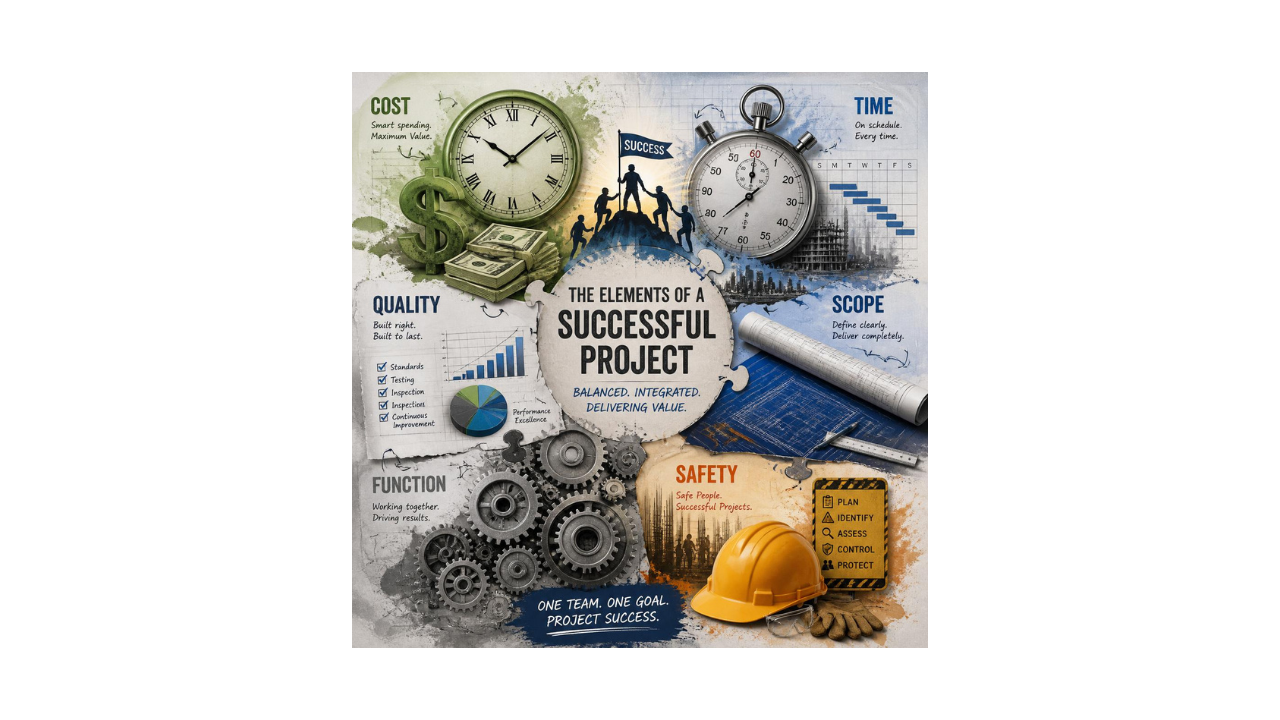
LG3: What Does Project Success Actually Mean?
We often talk about whether a project has been successful as though the answer should be obvious. Was it delivered on time? Did it stay within budget? Was the quality good? Did it achieve what it set out to achieve?
The difficulty is that all of these questions can have different answers.
A project can be delivered on time and still be considered a failure. It can exceed its budget and still create enormous value. It can deliver exactly what was specified, but discover that the specification itself was wrong. Equally, a project can appear to be successful from the project team's perspective while being judged very differently by the people who ultimately have to live with the outcome.
So perhaps the better question is not simply “Was the project successful?”
It is:
“What did success mean for this project?”
Six dimensions of success
When we think about project success, I believe there are six dimensions that are particularly useful to consider:
Cost. Safety. Quality. Scope. Function. Timing.
At first glance, these might look like six separate measures that can simply be scored at the end of a project. In reality, they are much more closely connected.
Change one and you will almost certainly put pressure on one or more of the others.
Suppose a project has to be completed earlier than planned. We may need to spend more money to increase resources, work longer hours or change the way the project is delivered. Perhaps we reduce some of the scope to protect the deadline.
If the budget is reduced, we may have to reconsider the specification, the materials, the scope or even the functionality we originally intended to provide.
If the required quality is increased, there may be consequences for both cost and time.
And if we discover that the finished project does not actually perform the function it was intended to perform, then being on time and on budget may suddenly seem rather irrelevant.
This is why I don't see these six dimensions as six independent boxes to tick. They are more like six competing forces that have to be balanced throughout the life of a project.
Not everything can be the priority
One of the most useful things we can do at the beginning of a project is to understand which of these dimensions are genuinely fixed and which have some ability to move.
Every project will tell us that everything is important.
Of course it is.
But eventually, most projects face a moment when something has to give.
The question then becomes: what are we prepared to change, and what are we not prepared to change?
That is where the difference between project management and project leadership starts to become apparent.
If the opening date is absolutely fixed, perhaps we have to spend more to achieve it.
If the budget is genuinely immovable, perhaps the scope has to reduce.
If safety cannot be compromised, then perhaps the program has to move.
If the function of the project is fundamental to the business case, perhaps we need to accept additional cost or time to make sure the outcome actually works.
These aren't necessarily signs of a project going wrong. They may simply be evidence that we understand what matters most.
The problem occurs when we haven't had the conversation in advance.
The danger of measuring success too late
One of the traps in project management is waiting until the end to decide whether the project was successful.
By then, the decisions have already been made.
The better approach is to establish the definition of success early and then use it to guide the difficult decisions that inevitably arise during delivery.
Imagine two projects, both facing a £5 million overspend.
In the first, the additional money protects a critical safety requirement and keeps the project operationally viable. In the second, the same £5 million simply adds features that nobody really needs.
The financial outcome is identical.
The project decisions are not.
That is why cost alone cannot tell us whether a project has been successful.
The same principle applies to time, quality, scope and all the other dimensions.
London 2012 is a useful example
The London 2012 Olympic and Paralympic Games provide a particularly interesting example of this balance.
There was one criterion that was fundamentally immovable: the Games had to happen when they were scheduled to happen.
There was no realistic option to say that the venues were 95% complete and perhaps the opening ceremony could be postponed for six months.
The date was fixed.
That made timing an unusually powerful constraint, but it didn't make the other five dimensions disappear. The program still had to deal with cost, safety, quality, scope and function.
The challenge was therefore not simply to “finish on time”. It was to make decisions throughout the that protected the fixed deadline while maintaining the other requirements to an acceptable level.
That is what makes project success so interesting.
The priority isn't always the same, and it isn't always obvious at the beginning.
So what should we ask?
Perhaps every major project should begin with six simple questions.
What does success mean in terms of cost?
What must we achieve in terms of safety?
What level of quality is genuinely required?
What is the scope we have committed to deliver?
What function or outcome must the project provide?
And when does it need to be delivered?
Then comes the more difficult question:
If we have to compromise one, which one moves?
That question is worth answering before the pressure arrives, rather than trying to answer it when the project is already in trouble.
Over the next six LG3 blogs, we'll take each of these dimensions in turn. We'll look at what they really mean, how they can be measured, where projects commonly get them wrong, and what happens when one becomes more important than the others.
We'll start with Cost.
Because while staying within budget sounds like one of the simplest measures of project success, the more interesting question is whether the money we spent actually delivered the value we intended.
Next time: LG3 — Cost: What Are We Really Trying to Optimise?
Stay connected with news and updates!
Join our mailing list to receive the latest news and updates from our team.
Don't worry, your information will not be shared.
We hate SPAM. We will never sell your information, for any reason.