That's Not My Job
Aug 27, 2026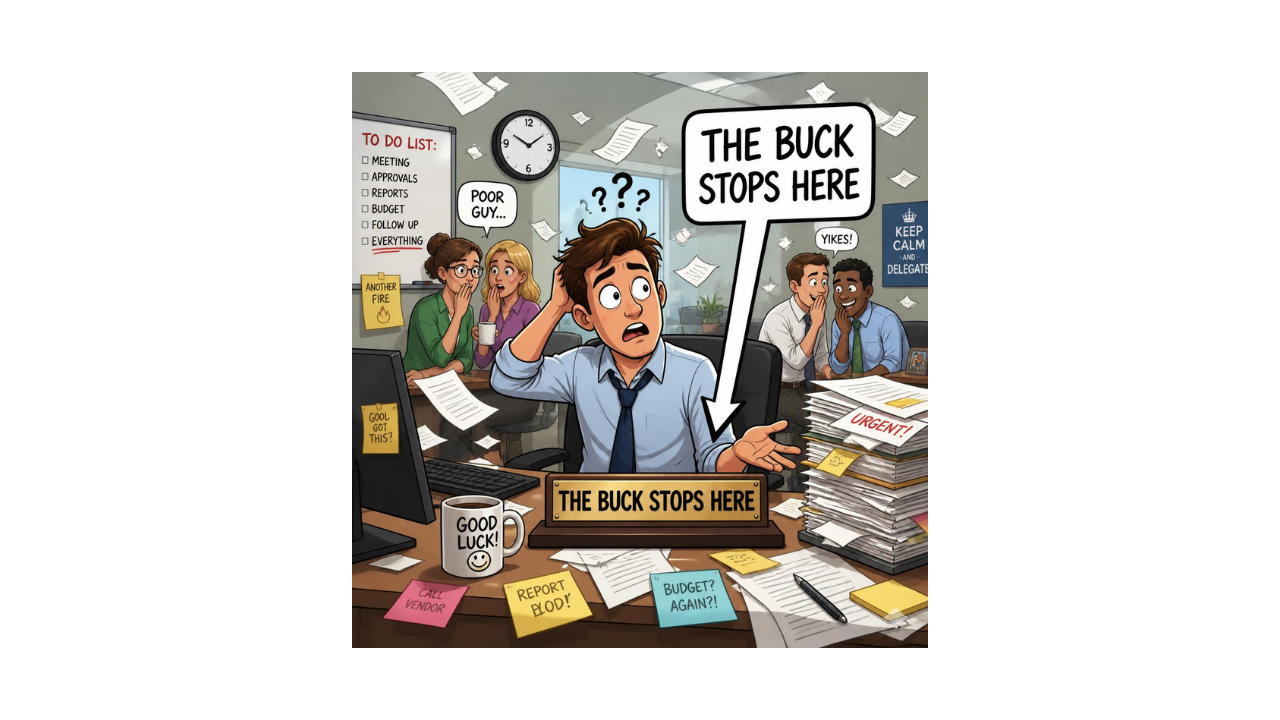
“That’s Not My Job”: The Five Words That Kill Good Governance
There are five little words capable of making a problem travel through an organization faster than an expense report nobody wants to approve:
“That’s not my job.”
Technically, the person saying it may even be correct.
It isn't in their job description.
Their department doesn't own the process.
Someone else has responsibility.
There's probably a lovely RACI chart somewhere proving it.
And meanwhile...
the problem is still sitting there.
Meet the Corporate Hot Potato
We've all seen it.
Finance says it's a Procurement issue.
Procurement says Operations owns the vendor relationship.
Operations says Legal wrote the contract.
Legal says Project Management approved the change.
Project Management says Finance paid the invoice.
Internal Audit arrives six months later and asks the apparently revolutionary question:
“Did anybody actually look at the whole thing?”
Silence.
Then someone opens the RACI chart.
Responsibility Has Boundaries. Risk Doesn't.
Clear responsibilities are essential.
I'm certainly not suggesting everyone should wander around fixing everyone else's problems. That would produce chaos rather than governance.
But there is an important distinction between:
“I don't own this.”
and
“This doesn't concern me.”
You may not own the problem.
But you may be the person who sees it.
And sometimes that matters enormously.
The accounts payable employee may not manage the construction project, but she notices unusual invoices.
The project manager may not work in cybersecurity, but he discovers a contractor sharing credentials.
The auditor may not own operations, but she notices the same control failure appearing in three different departments.
The employee may not manage the vendor relationship, but he sees something that doesn't make sense.
The question isn't always:
“Is this my responsibility?”
Sometimes it should be:
“Who needs to know what I know?”
Silos Are Wonderful Places for Problems to Hide
Organizations need departments.
Specialization makes sense.
We want accountants who understand accounting, engineers who understand engineering, IT professionals who understand technology and auditors who understand auditing.
The trouble begins when specialization becomes isolation.
Finance sees one piece.
Operations sees another.
HR sees another.
Procurement sees another.
IT sees another.
Individually, nothing looks particularly alarming.
But put the pieces together and suddenly...
Oh.
That's a rather different picture.
Fraud loves organizational gaps.
Project failure loves them too.
So do cyber risks, vendor problems and control breakdowns.
Because while everyone is carefully managing their own square on the organizational chessboard, nobody notices what is happening across the board.
“I Told Someone” Isn't Always Enough
Here's another favorite.
"I raised it."
Good.
With whom?
What happened?
Did they understand the significance?
Was anything done?
Did you follow up?
There comes a point where raising the concern once and walking away may not be enough.
That doesn't mean endlessly escalating every disagreement until the CEO receives an email about the broken coffee machine.
It means understanding the difference between:
I communicated the issue
and
the issue was addressed.
Those aren't the same thing.
Ownership Should Be Clear Before the Problem Arrives
Good governance shouldn't require everyone to begin searching for the owner after something goes wrong.
For significant risks, organizations should already understand:
Who owns the risk?
Who operates the controls?
Who monitors performance?
Who receives exceptions?
Who can escalate concerns?
Who has authority to act?
And importantly:
Who steps in when the normal process doesn't work?
Because eventually something will happen that doesn't fit neatly inside the boxes.
It always does.
Internal Audit Has an Interesting Seat at the Table
Internal auditors have a particularly valuable vantage point because we travel across the organization.
We see Finance.
Operations.
Technology.
Projects.
Procurement.
Compliance.
Governance.
Sometimes our greatest value isn't discovering something nobody else knew.
It's recognizing that five different people knew five different pieces of the same problem.
That's when Internal Audit can help connect the dots.
Not by taking ownership of management's risks.
But by asking whether the people who do own those risks are seeing the whole picture.
Try Changing Five Words
The next time you're tempted to say:
“That's not my job.”
Try replacing it with:
“Who needs to know this?”
Those five words create a very different organization.
They don't blur accountability.
They strengthen it.
They encourage people to look beyond their immediate responsibilities without pretending they own everything they see.
And most importantly, they make it harder for important information to fall into that mysterious corporate canyon known as:
Somebody Else's Problem.
Learn. Connect. Speak Up. Grow.
At LG3, learning isn't just about becoming better at your own job.
It's about understanding how your job connects with everyone else's.
Because organizations aren't collections of departments.
They're systems.
And when one part of the system sees something important, the rest of the system may need to hear about it.
So yes, perhaps technically...
It's not your job.
But if you're the only person who noticed it?
It might just be your responsibility to say something.
Learn and Grow with LG3.
Have you ever watched a problem bounce between departments because nobody believed they owned it?
Stay connected with news and updates!
Join our mailing list to receive the latest news and updates from our team.
Don't worry, your information will not be shared.
We hate SPAM. We will never sell your information, for any reason.