Stop before you post Back to School photos
Sep 01, 2026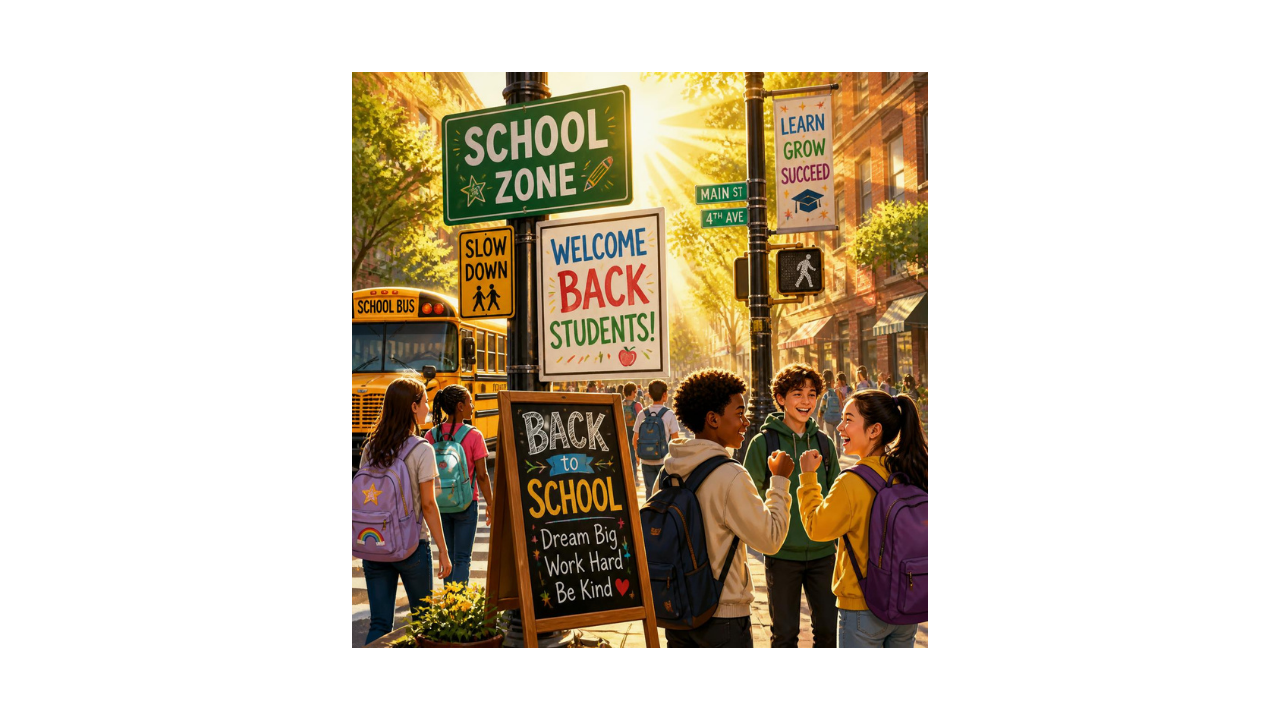
Smile! You Just Told the Internet Where Your Kid Goes to School
A Back-to-School Reminder About Kids, Photos and Social Media
It’s back-to-school time! And at this time of year, I give this warning and it is worth repeating.
The backpacks are packed. The pencils are sharpened. The new shoes are still clean, although we all know that particular miracle has a very short shelf life.
And across Facebook, Instagram and other social platforms, proud parents and grandparents are posting one of my favorite traditions: the first-day-of-school photo.
You know the one.
There stands your adorable child, backpack on, huge smile on their face, holding a sign that says:
FIRST DAY OF FOURTH GRADE!
Name: Emma
Age: 9
School: Lincoln Elementary
Teacher: Mrs. Smith
Favorite Activity: Soccer
When I Grow Up: Veterinarian
CLICK.
POST.
SHARE.
Grandma loves it. Aunt Susan comments three heart emojis. Your best friend wants to know when Emma got so tall.
It's adorable.
But there's somebody else I'd like you to imagine looking at that photograph.
A complete stranger.
What did you just tell them?
Quite possibly, a lot more than you intended.
A Photograph Isn't Just a Photograph Anymore
Look at that cute first-day-of-school picture again, but this time don't look at your child.
Look at everything else.
Can you see the school name or logo on the uniform?
Is your house number visible behind them?
Can you see a street sign?
Does the little back-to-school board contain their name, age, grade or teacher?
Did you tag the location?
What did you write in the caption?
Maybe something completely innocent like:
“Can't believe my baby is starting fourth grade! Off to Lincoln Elementary and she got Mrs. Smith, the teacher she wanted! Bus arrives every morning at 7:45!”
Lovely.
Except we may have just provided a child's name, approximate age, school, grade, teacher and morning routine.
We thought we posted a photograph.
We posted data.
One Little Detail? Probably Not. Ten Little Details? That's Different.
Here's where I put on my fraud-and-risk hat.
Information becomes much more powerful when someone can connect it with other information.
One Facebook post identifies a child's school.
A birthday post from six months ago reveals the child's age and birthday.
Soccer pictures identify the team.
Another post mentions Wednesday evening practice.
A photograph outside the house shows the number.
A holiday post tells everyone the family is away.
And maybe somewhere along the way we've even introduced the family dog.
Each piece by itself seems harmless.
Together?
We're building a jigsaw puzzle.
And the internet is exceptionally good at keeping puzzle pieces.
I'm not suggesting that posting your child's photograph means something terrible will happen. Fear isn't useful here, and that's not my message.
Awareness is.
We protect information not because we know exactly how someone might misuse it, but because once information is public, we don't necessarily control what happens to it next.
There's Another Person in This Conversation: Your Child
There's a bigger issue here that goes beyond back-to-school photographs.
Many children today have a digital footprint long before they're old enough to understand what a digital footprint is.
Their first photograph.
First birthday.
First tooth.
First steps.
First day of school.
School play.
Football match.
Dance recital.
Family holiday.
Awards.
Funny moments.
Embarrassing moments.
We are documenting childhood in a way previous generations never could.
And there is something wonderful about that.
But there's an important difference between preserving a memory and publishing a memory.
Our family photo albums once sat on a shelf in the living room.
Today's family album may live online, potentially accessible to far more people than we ever imagined.
And the person whose life we're documenting may have had absolutely no say in it.
That doesn't mean stop taking pictures.
Good grief, no.
Take the pictures.
It means we should think about which pictures belong online and which memories might be better kept for ourselves.
Try the Five-Second Photo Audit
Before you post a photograph of your child, stop for five seconds.
Look at the photograph as though you were a stranger.
Ask yourself:
-
Can I identify the child's school, teacher or grade?
-
Is a full name, age or birthday visible?
-
Is the school uniform or logo identifiable?
-
Can I see a house number, street name or recognizable location?
-
Does the post reveal a bus stop or regular routine?
-
Is location information attached?
-
Are other children visible whose parents may not want their images posted?
-
Does my caption reveal information the photograph doesn't?
And here's one we sometimes forget:
Who can actually see this post?
When did you last check your privacy settings?
Who are your followers?
Who are your “friends”?
And do you actually know all of them?
If you've been on social media for years, you may have accumulated quite the collection: old colleagues, former neighbors, people from conferences, friends of friends and that mysterious Dave you apparently became friends with in 2016.
Sorry, Dave.
It may be time for a little digital housekeeping.
Don't Just Protect Kids. Teach Them.
As children get older, bring them into the conversation.
Rather than simply telling them social media is dangerous, teach them to think critically about information.
Before posting, ask:
What am I showing?
Who can see it?
What else could someone learn from it?
Would I be comfortable with someone I don't know seeing this?
Those aren't just social-media questions.
They're digital-literacy questions.
And in a world of AI, facial recognition, enormous amounts of publicly available information and increasingly sophisticated fraud, digital literacy is becoming a basic life skill.
Learn It. Grow With It. Own It.
This is exactly the kind of everyday issue behind what we're building at LG3.
Learn It.
Understand that photographs and posts may reveal information beyond what you intended to share.
Grow With It.
Technology evolves. Social media evolves. AI evolves. The ways information can be collected and connected evolve. Our habits need to evolve too.
Own It.
Take control of your digital footprint. And while your children are too young to make those decisions for themselves, help protect theirs.
Because eventually, that digital footprint becomes theirs to inherit.
One Last Look Before You Hit POST
So here's my back-to-school challenge.
Take that adorable photograph.
Capture the new backpack.
Capture the missing front tooth.
Capture those brand-new shoes before they meet their first mud puddle.
Capture the five-year-old who can't wait to run through the school doors.
And absolutely capture the teenager who looks as though asking for ONE photograph has destroyed every shred of dignity they possessed.
These moments go by far too quickly.
But before you hit POST, take five seconds.
Look behind them.
Look beside them.
Read the sign.
Check the caption.
Check the location.
Then ask:
What could someone who doesn't know my family learn from this?
If the answer is more than I'd like...
Crop it.
Cover it.
Change the caption.
Or maybe keep that particular photograph just for the people you love.
Take the picture. Keep the memory. Share the joy.
Just don't accidentally...
share the roadmap.
Learn It. Grow With It. Own It.
LG3 (lg3center.net)
Stay connected with news and updates!
Join our mailing list to receive the latest news and updates from our team.
Don't worry, your information will not be shared.
We hate SPAM. We will never sell your information, for any reason.