
Scope: Did you get what you wanted,needed and paid for
Aug 20, 2026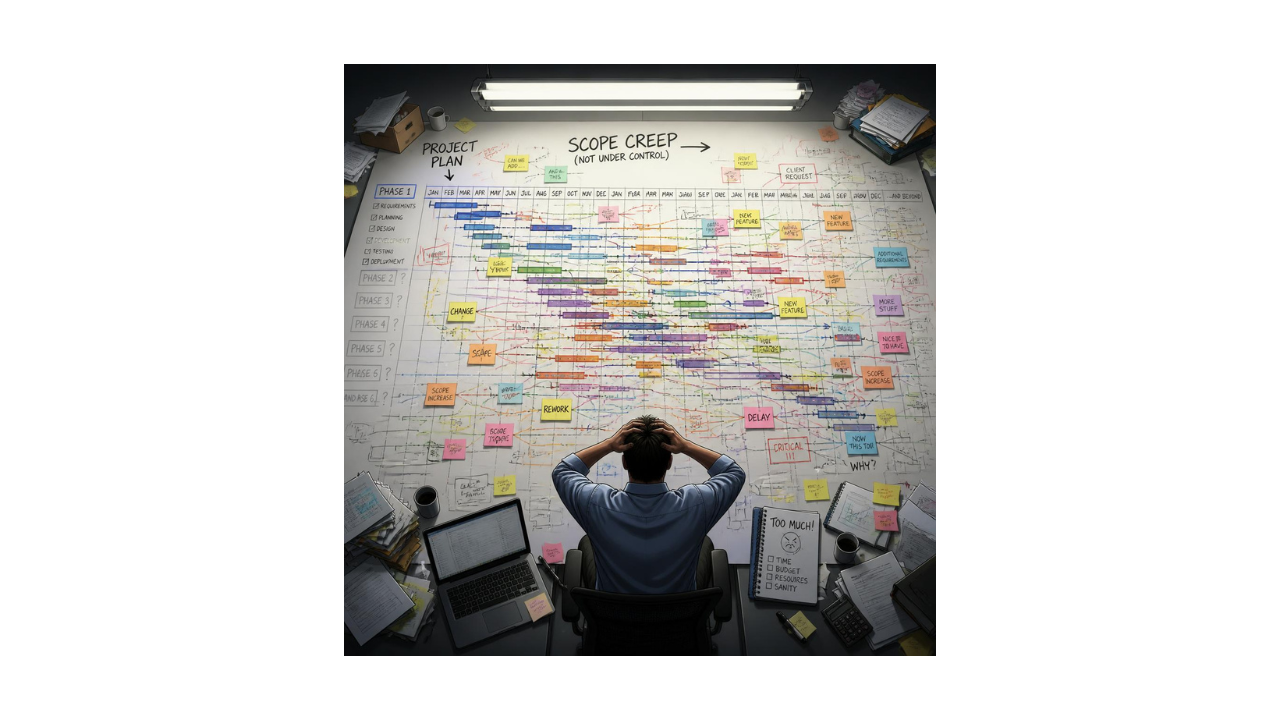
Project Success: When Scope Starts Creeping Down the Aisle
The invitations have gone out. The venue is booked. The dress is hanging safely in the closet. The flowers are ordered, the photographer has been paid a deposit, and someone has finally convinced Uncle Bob that no, he cannot give a 45-minute toast.
The wedding plan is set.
Or so everyone thinks.
Then someone says, “Wouldn’t it be lovely to have a champagne fountain?”
Lovely.
Then the bride sees a video of a wedding with fireworks.
Also lovely.
The groom decides a DJ suddenly isn’t enough. Maybe a live band?
The mother of the bride thinks the centerpieces look a little plain. The bridesmaids want professional hair and makeup. Someone suggests a photo booth. Someone else wants personalized favors. And apparently we now need white doves.
Welcome to scope creep.
What Exactly Is Project Scope?
Project scope defines what the project is supposed to deliver and, just as importantly, what it is not supposed to deliver.
Think of it as the fence around the project. Inside the fence is what we agreed to build, create, install, implement, renovate, launch, or deliver.
Outside the fence?
That may be a wonderful idea. It may even be a brilliant idea.
But it isn't part of this project unless someone makes a conscious decision to bring it inside the fence.
A well-defined scope should make the project's expected outcomes clear enough that the team, management, contractors, stakeholders, and eventually auditors can understand what success is supposed to look like.
Without that clarity, everyone may be working very hard while heading toward completely different finish lines.
Scope Creep Rarely Arrives Wearing a Name Tag
The dangerous thing about scope creep is that it rarely announces itself.
Nobody walks into Monday's project meeting and says:
“Good morning. I would like to increase costs, delay completion, confuse responsibilities, and make everyone slightly miserable.”
Scope creep usually sounds perfectly reasonable.
“While we're doing this, could we also...?”
“It would make sense to add...”
“The executive team would really like...”
“This shouldn't take very long...”
“Can you just...?”
Ah yes. Can you just.
Three innocent little words that have probably added millions of dollars and thousands of hours to projects around the world.
One small addition may genuinely be small. But five, ten, or twenty “small” additions can quietly transform the project.
Our intimate 75-person wedding is now hosting 150 guests, serving three entrées, featuring a twelve-piece orchestra, fireworks, a champagne fountain and, yes, the white doves.
Meanwhile, Dad is staring at the budget wondering when he accidentally agreed to finance the coronation.
Scope Affects Everything Else
This is where scope becomes much more than a project management definition.
Change the scope and you may change the cost.
Change the scope and you may change the schedule.
Change the scope and you may affect quality, resources, risk, procurement, staffing, technology, safety, communications, and almost every other moving part of the project.
That is why scope cannot be managed in isolation.
Suppose a construction project adds another floor to a building. That isn't simply “more building.” It could affect design, engineering, permits, materials, labor, equipment, insurance, schedule, financing, testing and commissioning.
Similarly, adding a major feature to a technology implementation may require more programming, testing, cybersecurity review, training, documentation, licensing, and support.
The question should never be simply:
Can we do it?
The better question is:
What happens to the rest of the project if we do?
Scope Change Is Not the Enemy
This distinction matters.
Scope change is not automatically bad. Uncontrolled scope change is.
Projects evolve. Business conditions change. Regulations change. Technology changes. Stakeholders learn things they did not know when the project began.
Sometimes changing the scope is exactly the right decision.
The problem begins when changes slide quietly into the project without anyone properly considering their consequences.
A healthy scope change process should ask:
- What exactly is changing?
- Why is the change necessary?
- Who requested it?
- What will it cost?
- What does it do to the schedule?
- What new risks does it create?
- Are additional resources required?
- Does it affect other deliverables?
- Who has authority to approve it?
- Has the approved change been incorporated into the project's baseline?
That last question is important.
If we approve something but continue measuring the project against the old scope, our project reporting can quickly become meaningless.
And This Is Where Auditors Should Get Curious
For auditors, scope can tell quite a story.
Start with the original business case, charter, contract, statement of work, requirements, drawings, specifications, or other documents defining what the project was supposed to accomplish.
Then compare that original vision with what is actually being delivered.
What changed?
Why?
Who approved it?
How much did it cost?
Was the schedule adjusted?
Were the changes individually reasonable but collectively significant?
And here's one of my favorite questions:
Is anyone still keeping track of the original project?
Because after enough modifications, additions, substitutions and “while you're at its,” the project being delivered may barely resemble the project originally approved.
That doesn't necessarily mean something went wrong.
But somebody should be able to explain the journey from there to here.
Watch the Little Changes
Major scope changes usually receive attention because they are major.
It is the little ones that can be sneaky.
A $500,000 change on a $10 million project will probably attract attention.
Fifty $10,000 changes?
Each may look relatively harmless.
Together, they are the same $500,000.
Auditors and project managers should therefore look beyond individual changes and examine the cumulative effect of scope growth.
Patterns matter.
Repeated changes may indicate weak planning, incomplete requirements, design deficiencies, poor stakeholder engagement, inadequate governance, contractor strategy, or simply a project that was approved before anyone truly understood what was needed.
Define the Fence Before You Start Building
Good scope management begins before the project gets busy.
Define what success looks like. Establish deliverables. Clarify assumptions and exclusions. Identify who can authorize changes. Document decisions. Then make sure everyone understands where the fence is.
Because people will inevitably want to move it.
Sometimes moving it will absolutely be the right thing to do.
Just make sure someone knows who moved it, why they moved it, what it cost, and where the new fence is.
Otherwise, you may begin with a simple wedding, a manageable budget and a perfectly sensible plan...
…and somehow end up at midnight with fireworks exploding overhead, a twelve-piece orchestra playing, 150 guests drinking from a champagne fountain, and six white doves refusing to leave the reception hall.
And somewhere in the corner, the project manager is whispering:
“This was not in the original scope.”
The Bottom Line
Scope provides the boundaries that turn an idea into a manageable project. Define it clearly, control changes thoughtfully, and understand the ripple effects when those boundaries move.
Projects do not usually lose control in one spectacular moment. More often, they drift there one perfectly reasonable little request at a time.
Know the scope. Guard the scope. And when it needs to change, change it deliberately.
Because successful projects don't happen by accident.
They happen when people know what they are trying to deliver, why they are delivering it, and where the boundaries lie.
Learn the fundamentals. Grow your confidence. Learn and Grow with LG3.
Stay connected with news and updates!
Join our mailing list to receive the latest news and updates from our team.
Don't worry, your information will not be shared.
We hate SPAM. We will never sell your information, for any reason.